1. Depletion scenarios
Depletion is estimated from the times that a location is fished (fishing frequency) and the proportion of biota that are killed by a single pass of a mobile fishing gear (depletion rate d). Fishing frequency was estimated for mobile fishing gears only as the sum of area that is annually fished (or the swept area) divided by the surface area of the studied grid cell, defined as the Swept Area Ratio (SAR). Depletion should typically be estimated at high spatial resolution (here: 0.05° resolution), because mobile fisheries are spatially clustered (Hiddink et al. 2017, Amoroso et al. 2018). Depletion is estimated at métier level.
Benthic impact risk assessments have categorized fishing métiers to discriminate for the width and penetration depth of the gears, such as the Benthis-métiers (Eigaard et al. 2016, Rijnsdorp et al. 2020). Mixed fisheries models typically categorize fisheries using fleet and métiers, whereby fleets are based on country, broad gear groups and vessel length while mixed fisheries métiers are defined within fleets in terms of catchability of a commercial fish stock (Garcia et al. 2017, Kühn et al. 2023).
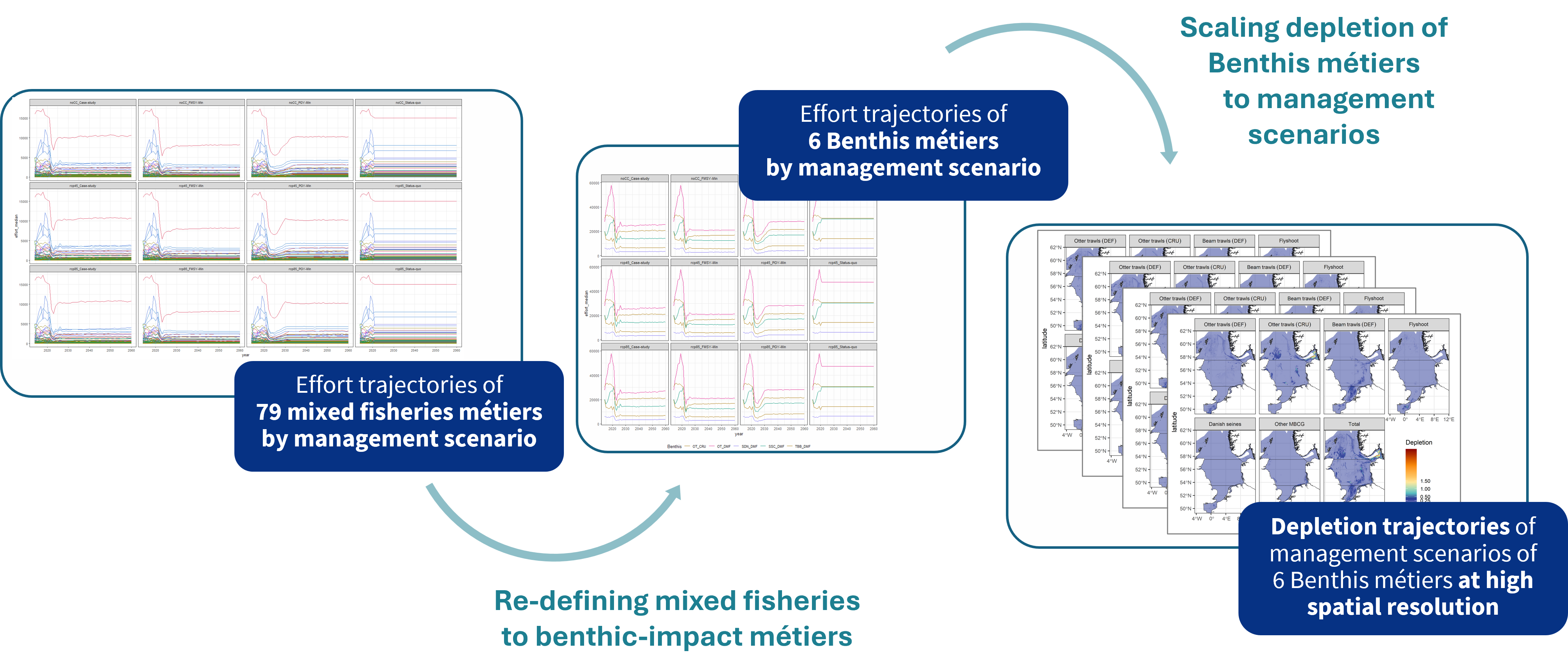
Data on Benthis métiers typically involves fishing frequencies at higher spatial resolution (0.05° by 0.05°) than mixed fisheries métiers, while mixed fisheries métiers comprise data on catch composition of commercial fish stocks at higher and more appropriate resolution of the fishing métiers. To estimate depletion of mixed fisheries scenarios, we first estimate the depletion of Benthis métiers, and then aggregated those Benthis métiers to match the mixed fisheries métiers and enable assessment of their benthic impact risk. Matching Benthis métiers to mixed fisheries métiers allows the estimation of benthic impact risk for a range of mixed fisheries scenarios. Matching datasets of Benthis-métiers with mixed fisheries métiers requires downscaling the analysis to the lowest common denominator, implying a lower resolution categorization of fishing métiers for benthic impact assessment.